Guides · 5 min read
Diamond microdermabrasion: what it is and what to expect
By Marta Fernández · Updated
Diamond microdermabrasion has a lot going for it: you notice the difference straight away and there’s no recovery time. But precisely because it’s so easy and pleasant, people sometimes expect things it can’t deliver. This guide explains what it is, what a session is like, which results are realistic and when another option makes more sense.
What microdermabrasion is
Microdermabrasion is a mechanical exfoliation of the outermost layer of the skin, the stratum corneum. Unlike a chemical peel, which uses acids, it works by controlled abrasion: the surface is polished and the loosened cells are removed.
There are two main types:
- Crystal microdermabrasion: a stream of fine particles hits the skin and is then suctioned away.
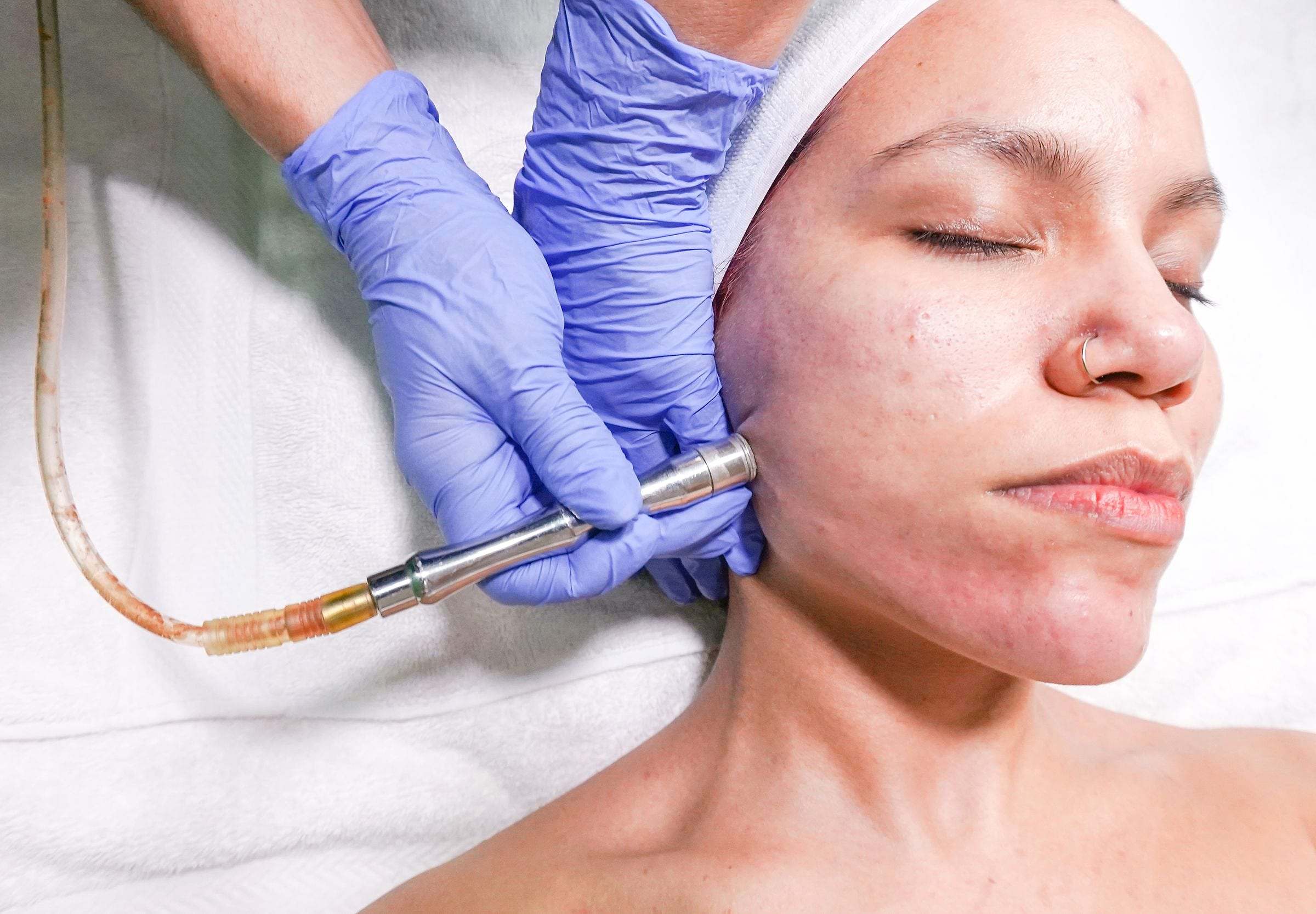
- Diamond microdermabrasion: a diamond-coated head polishes the skin on contact while gentle suction collects the loosened cells in the same movement.
The diamond version leaves no particles on the skin or in the room, and allows the grit of the head and the suction strength to be changed for each area. That’s why it’s the most widely used version in beauty treatments today.
What a session is like, step by step
A session usually takes 30 to 45 minutes.
- Assessment and cleanse. We look at your skin in good light, ask about your routine and remove make-up and oil.
- Choosing the head and suction. Thick, oily skin can take a coarser grit; fine or dry skin needs a gentler one.
- Polishing area by area. The head is glided in short passes while the skin is held slightly taut. You’ll feel firm friction and light suction. The forehead, nose and chin can take a little more intensity than the cheeks.
- Soothe and hydrate. A mask or serum, moisturiser and sunscreen.
Afterwards, your skin may look a little pink for a few hours, especially where it’s finer. There’s no visible flaking in the following days, which is one of its advantages over a chemical peel.
Realistic results
After one session
The first thing you’ll notice is how it feels: softer and smoother. It also reflects light better, so it looks brighter. Make-up sits better too. It’s a lovely effect, but a temporary one: it lasts until dead cells build up on the surface again.
After a course
With a course of 4 to 6 sessions, every 2–3 weeks, texture is gradually refined in a more lasting way. Thickened skin feels finer, pores look cleaner and less noticeable, and tone may look a little more even if there were very light, superficial marks. After that, a maintenance session every month or two helps keep it that way.
What it doesn’t do
- It doesn’t fill wrinkles or add firmness. Fine lines caused by dryness look a little softer, but expression lines are still there.
- It doesn’t erase indented scars. It can soften the look of very superficial marks; indented acne scars need other techniques.
- It doesn’t work on melasma or deep pigmentation. And with any mark that changes, see your dermatologist first.
- It doesn’t close pores. It leaves them cleaner, which isn’t the same thing.
Who it suits best
Diamond microdermabrasion is especially useful for thicker, combination or oily skin with uneven texture, for dull skin that needs a glow without days of flaking, and for anyone who prefers to avoid acids. It also suits people with busy diaries, as you can go straight back to work.
It’s less suitable for very fine skin, rosacea, marked thread veins or very reactive skin. In those cases there are gentler options at the centre.
Diamond microdermabrasion, facial or peel: how they fit together
They don’t compete as much as you might think; each has its role.
- Deep cleansing facial: if blackheads are your concern, you need manual extractions, which diamond microdermabrasion doesn’t do.
- Superficial chemical peel: resurfaces more evenly and works better on tone, but may cause flaking and needs more care in the sun.
- Diamond microdermabrasion: refines texture and adds glow with minimal downtime.
A common approach is to alternate: a deep cleansing facial when pores get congested, and diamond microdermabrasion in between to keep texture smooth.
Before your first session
Preparation is simple:
- Pause retinol, acids and scrubs at home two or three days beforehand.
- Avoid strong sun and tanning the week before.
- Don’t wax or thread the area in the days beforehand.
- If you have a cold sore, broken skin or a breakout of inflamed spots, let us know and we’ll move your appointment.
- Tell us if you use any prescription topical treatment or have taken isotretinoin in recent months.
You can come with make-up on: we always start by cleansing the skin.
Aftercare
- Broad-spectrum sunscreen every day, reapplied when you’re outdoors.
- No scrubs, acids or retinol at home for 2–3 days.
- Avoid direct sun, saunas and chlorinated pools for the first 24–48 hours.
- Moisturise more than usual.
As it doesn’t cause flaking, diamond microdermabrasion is one of the exfoliations that fits best with Málaga’s sunny months, always with sun protection and no beach in the following days. If you’re very tanned, we’ll wait.
At Narumi
At Narumi, on Calle Cristo de la Epidemia in Málaga city centre, Marta Fernández, an advanced aesthetics specialist, adjusts the head and suction to your skin at every session and will tell you plainly whether diamond microdermabrasion is what you need or whether another option will do more for you.
- Diamond microdermabrasion in Málaga: for texture and radiance.
- Deep cleansing facial: if blackheads are your priority.
- Superficial chemical peel: if you want to focus more on tone.
To plan the rhythm between sessions, you may find our guide on how often to get a facial useful.
| What you can expect | What not to expect | |
|---|---|---|
| After the first session | Skin that feels softer and looks brighter | A change that lasts for months from a single session |
| After a course | Finer texture and a slightly more even tone | Indented scars disappearing |
| Pigmentation | Very light, superficial marks look better | Any effect on melasma or deep pigmentation |
| Wrinkles and firmness | Fine lines from dryness look less visible | Wrinkles filled or a tightening effect |
Frequently asked questions
How long do the effects of diamond microdermabrasion last?
The smoothness and glow from a single session last for days or a few weeks, until your skin completes its renewal cycle. With a course and maintenance sessions, the improvement in texture holds up better. Your home routine and sunscreen make a big difference.
Does diamond microdermabrasion open the pores?
No, that's a common myth. By removing dead cells and surface oil, it makes pores look cleaner and less noticeable. Pore size depends mainly on your skin type and genetics; no exfoliation changes it for good.
Can I have diamond microdermabrasion if my skin is sensitive?
It depends how sensitive. With mildly sensitive skin, we adjust the grit and suction. With rosacea, marked thread veins or skin that reacts to everything, it isn't the right option; a hydrotherapy facial or an ultrasonic peel will be kinder.
Can it be done on the neck and décolletage?
Yes, more gently, because the skin there is finer. It's a good way to match the texture of your face and neck. We assess it in the treatment room and adapt the intensity. On the décolletage you also need to be very consistent with sunscreen, as it's a very exposed area.
How is it different from crystal microdermabrasion?
Crystal microdermabrasion blasts fine particles onto the skin and then suctions them away. Diamond microdermabrasion uses a head with a fixed abrasive surface, with no loose particles. It's cleaner, leaves no residue and gives better control over intensity area by area.