Guides · 5 min read
What Is Kobido? The Japanese Facial Massage and What to Expect
By Marta Fernández · Updated
If you’ve been looking for facials without devices, you’ve almost certainly come across Kobido, often under the name “Japanese facelift”. It’s one of the best-known facial massages, and also one of the most prone to exaggeration. Here we explain where it comes from, what a session involves and what you can really expect.
Where Kobido comes from
Kobido comes from anma, Japan’s traditional massage, and its name is usually translated as “ancient way of beauty”. Tradition places its origins in 15th-century Japan and links it to families of masters who are said to have handed the technique down from one generation to the next, long reserved for circles close to the imperial court. As with so many traditions, the exact history blends documented fact and storytelling: what has definitely come down to us is a very recognisable style of facial massage.
In recent decades, masters of that school introduced it outside Japan, and the name has become popular ever since. Today, “Kobido” is also used more broadly for facial massages inspired by that tradition. It’s useful to know: not every “Kobido” is the same, and it’s worth asking how each salon does it.
What the massage involves
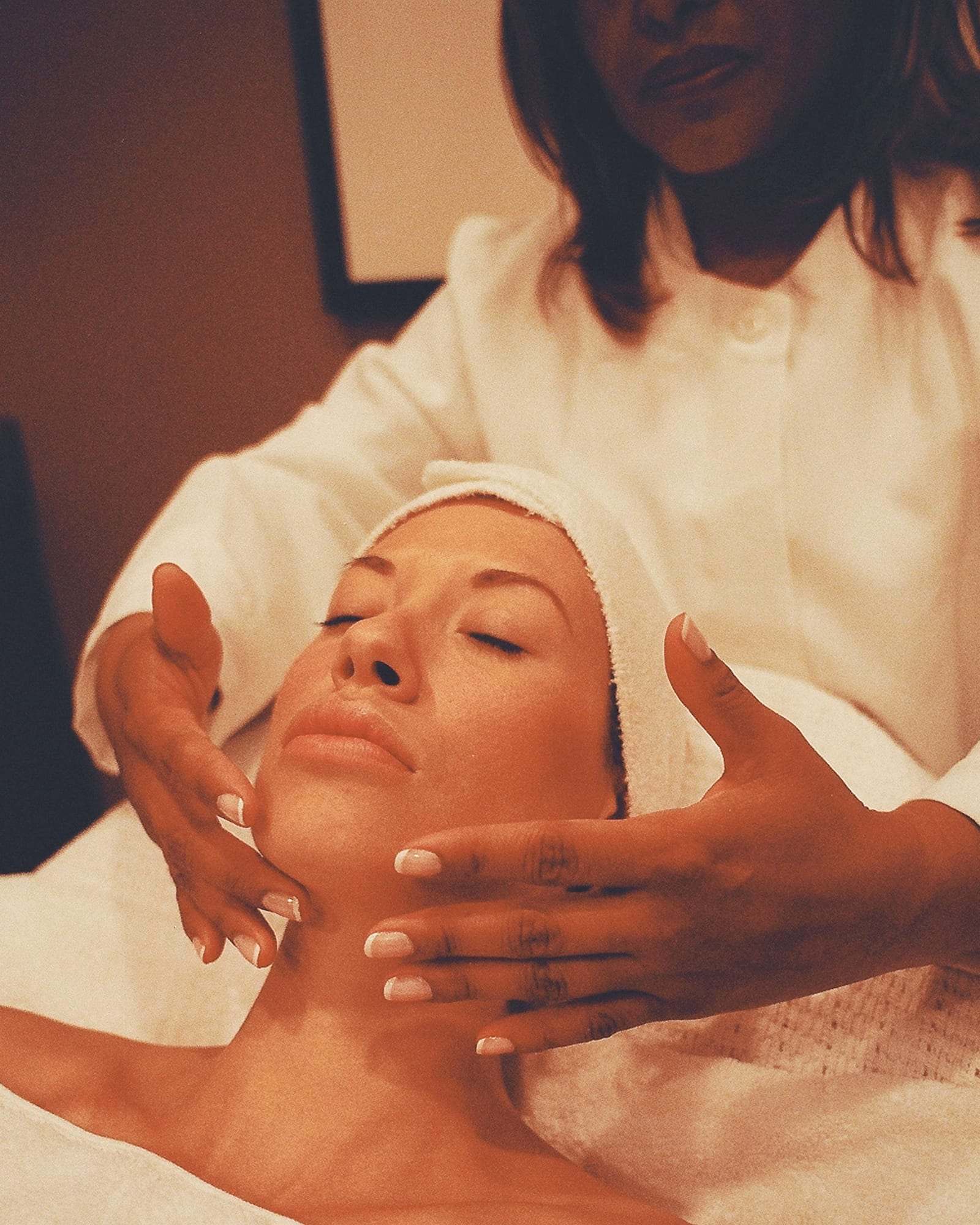
What sets Kobido apart from a classic facial massage is its rhythm. It combines:
- Quick, rhythmic movements, almost like light tapping and vibration, that liven up the look of the skin.
- Gentle pressure on specific points, inherited from anma, which helps relax your expression.
- Drainage movements, slow and directed, that leave your face feeling less puffy.
- Enveloping strokes to open and close the session on the neck, décolletage and shoulders.
The result is a session with changes of tempo that keeps you engaged while also being deeply relaxing. It’s common for people to doze off during the slower passages.
How it leaves your skin
The most immediate effect is a rested expression: your forehead, brow and jaw feel looser. Your skin looks brighter, with a livelier tone, and your face less puffy. You’ll see the tightening effect when you look in the mirror straight afterwards.
With regular sessions, that toned look lasts longer. What Kobido doesn’t do is change the structure of your skin: it doesn’t fill folds, lift marked sagging or erase deep wrinkles. If that’s what you’re after, there are other options, which we go through in our guide on facial sagging and non-invasive options.
What Kobido isn’t
You’ll often read that Kobido relieves migraines, solves teeth grinding or replaces a facelift. That’s not how we see it. It’s a wellbeing and relaxation massage with a visible cosmetic effect, not a health treatment. If you have migraines, facial pain or clench your teeth, your doctor or dentist is the right person to assess it. A session that leaves your jaw more relaxed is a pleasant feeling, not a solution.
Nor is it a facelift: the nickname “Japanese facelift” describes the tight, lifted feeling you have as you leave, not a surgical result.
Who it’s for
Kobido particularly suits:
- People who want a wellbeing facial without devices, needles or acids.
- Anyone who holds tension in their face (screens, concentration, stress) and wants to switch off.
- Anyone with an event coming up who wants to look their best with nothing that irritates the skin.
- Men and women alike: no make-up or special aftercare is needed afterwards.
- Anyone looking for a safe-bet gift, as you don’t need to know anything about the recipient’s skin.
- Those already following a firming treatment who want gentle maintenance between courses.
It’s not a good time if your skin is irritated, or you have an inflamed acne or rosacea flare-up, an active cold sore, recent fillers or threads, a fever or feel generally unwell.
Your first session, step by step
If you’ve never had Kobido before, this is what usually happens. You arrive and we have a quick chat about your skin and anything we should bear in mind, such as recent fillers or particularly reactive skin. You settle onto the treatment bed and we cleanse your face. The massage then begins on the neck and shoulders, to release tension before reaching the face, and continues with the facial sequences, alternating rhythms. The close is slow and calm, and we finish with moisturiser and sunscreen.
There’s no need to arrive without make-up or prepare anything special. If you can, keep some free time afterwards: many people prefer not to rush off after such a relaxing session. And if you shave, it’s best to do it the day before.
How often to have it
There’s no fixed number of sessions. A single one is enjoyable in itself. If you like the result, one session every one to four weeks maintains the effect. Between sessions, a simple routine can help and, if you enjoy it, a gua sha or facial roller used gently.
Kobido and other techniques
Kobido pairs well with techniques that work on the skin from a different angle. With a radiofrequency facial it makes a natural duo: the warmth works on firmness cumulatively and the massage brings relaxation and radiance. It also fits nicely after an LED light session or alongside a body massage, if total switch-off is what you’re after.
What’s best avoided is having it straight after techniques that leave the skin sensitive, such as a chemical peel or microneedling: it’s better to space them out.
At Narumi
At Narumi we perform Kobido entirely by hand, in a treatment room decorated with a mural of Mount Fuji, a pagoda and cherry blossom: a nod to the Japanese origins of our name. It’s carried out by Marta Fernández at our salon on Calle Cristo de la Epidemia, in Málaga city centre. You can book it on its own or as part of a ritual: the Ritual Narumi pairs it with a body massage, and the Silk Skin Ritual combines it with a radiofrequency facial and pressotherapy. If you’re thinking of giving it as a gift, our guide to wellness gift ideas in Málaga has plenty of inspiration.
| Kobido | Classic relaxing facial massage | Gua sha or roller at home | |
|---|---|---|---|
| Rhythm | Changing: fast and slow movements | Slow and enveloping | Slow, self-applied |
| Technique | Manual, with pressure points and drainage | Manual, with creams or oils | Stone or metal tool |
| What you notice | Relaxed expression, radiance, tightening effect | General relaxation | A fresh, de-puffed feeling |
| Ideal for | A wellbeing facial with visible results | Switching off | Maintenance between sessions |
Frequently asked questions
What does Kobido mean?
It's usually translated as "ancient way of beauty". The term refers to a Japanese tradition of facial massage which, so the story goes, was passed down through generations in families of masters of anma, Japan's traditional massage.
How long does the effect of Kobido last?
The tightening effect and radiance are noticeable as you leave and soften over the following days. With regular sessions, every one to four weeks, your face holds on to that rested look for longer. It varies with each person, their skin and how well they're sleeping.
Does Kobido use devices or cups?
Traditional Kobido is manual. Some salons combine it with cups, stones or devices, but those are variations. Ours is done with the hands alone.
Can I have Kobido if I have sensitive skin?
Generally yes, with the pressure and rhythm adapted. If you have a rosacea flare-up, inflamed acne or irritated skin, we'll wait for it to calm down and recommend you see your dermatologist.
Does it help with jaw tension?
Many people feel their jaw and temples are looser after the massage, because it's a relaxing session. But it isn't a treatment for teeth grinding or jaw pain: if you clench your teeth or have pain, please see your dentist or doctor.